


Porphyry vase, XVIII Century
An Imperial Porphyry Vase
Rome, early 18th century
Carved Egyptian imperial porphyry
Height: 36cm
Width: 58 cm
This striking porphyry vase belongs to a rare and highly prestigious group of Roman-carved vessels produced in the late 17th and early 18th centuries, when the art of re-working porphyry was deliberately revived for elite patrons.
Dealer’s Comment....
Porphyry is one of those stones that just mystifies me (and I think most antique dealers) and this is one of the sharpest and most precise examples I’ve seen outside a museum.
Imperial porphyry was quarried exclusively at Mons Porphyrius in the Eastern Desert of Egypt and, from the Roman Imperial period onwards, was inseparably associated with power, authority, and dynastic rule. Its deep purple colour echoed the costly Tyrian dye reserved for emperors, while its extraordinary hardness rendered it both technically challenging and symbolically enduring. By the early modern period the ancient quarries were long inaccessible; all later works were therefore carved from reclaimed fragments of ancient Roman porphyry - columns, slabs and architectural spolia - a fact that only heightened the rarity and value of newly executed pieces.
Rome was the centre of this renewed porphyry culture. Excavated ancient porphyry artefacts adorned papal palaces and Roman collections from the Renaissance onwards, and by the 17th and 18th centuries porphyry had become a material avidly sought by Europe’s most powerful collectors, including the Medici Grand Dukes of Tuscany, Cardinals Richelieu and Mazarin, and Louis XIV, who maintained a dedicated buying agent in Rome.
The present vase is consciously modelled on ancient Roman labra – shallow basins with a pronounced upper lip, frequently used as fountains in baths, gardens and courtyards. Monumental antique examples survive today in Rome and Florence, notably in Museo Nazionale Etrusco di Villa Giulia, Santa Maria Maggiore, and the Pitti Palace. Here, the ancient format has been reduced and refined for an interior decorative scheme.
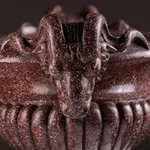
The ovoid body is divided into a boldly gadrooned lower register and a polished upper section beneath a pronounced overhanging lip, a format closely paralleled by an 18th-century porphyry vase in the Quirinal Palace, Rome. The powerful ram’s-head handles are a particularly distinguished feature and relate closely to a late 17th-century porphyry vase formerly in the collection of Louis XIV and now in the Musée national de la Renaissance.
Porphyry vessels of this scale, quality and sculptural ambition were luxury objects in the fullest sense – statements of erudition, wealth and classical learning, intended for collectors operating at the highest level. Today they remain among the most coveted survivals of Rome’s Grand Tour luxury arts.
Literature:
P. Malgouyres et al., Porphyre: La pierre pourpre des Ptolémées aux Bonaparte, Paris, 2003
D. del Bufalo, Porphyry: Red Imperial Porphyry. Power and Religion, Turin, 2012
Rome, early 18th century
Carved Egyptian imperial porphyry
Height: 36cm
Width: 58 cm
This striking porphyry vase belongs to a rare and highly prestigious group of Roman-carved vessels produced in the late 17th and early 18th centuries, when the art of re-working porphyry was deliberately revived for elite patrons.
Dealer’s Comment....
Porphyry is one of those stones that just mystifies me (and I think most antique dealers) and this is one of the sharpest and most precise examples I’ve seen outside a museum.
Imperial porphyry was quarried exclusively at Mons Porphyrius in the Eastern Desert of Egypt and, from the Roman Imperial period onwards, was inseparably associated with power, authority, and dynastic rule. Its deep purple colour echoed the costly Tyrian dye reserved for emperors, while its extraordinary hardness rendered it both technically challenging and symbolically enduring. By the early modern period the ancient quarries were long inaccessible; all later works were therefore carved from reclaimed fragments of ancient Roman porphyry - columns, slabs and architectural spolia - a fact that only heightened the rarity and value of newly executed pieces.
Rome was the centre of this renewed porphyry culture. Excavated ancient porphyry artefacts adorned papal palaces and Roman collections from the Renaissance onwards, and by the 17th and 18th centuries porphyry had become a material avidly sought by Europe’s most powerful collectors, including the Medici Grand Dukes of Tuscany, Cardinals Richelieu and Mazarin, and Louis XIV, who maintained a dedicated buying agent in Rome.
The present vase is consciously modelled on ancient Roman labra – shallow basins with a pronounced upper lip, frequently used as fountains in baths, gardens and courtyards. Monumental antique examples survive today in Rome and Florence, notably in Museo Nazionale Etrusco di Villa Giulia, Santa Maria Maggiore, and the Pitti Palace. Here, the ancient format has been reduced and refined for an interior decorative scheme.
The ovoid body is divided into a boldly gadrooned lower register and a polished upper section beneath a pronounced overhanging lip, a format closely paralleled by an 18th-century porphyry vase in the Quirinal Palace, Rome. The powerful ram’s-head handles are a particularly distinguished feature and relate closely to a late 17th-century porphyry vase formerly in the collection of Louis XIV and now in the Musée national de la Renaissance.
Porphyry vessels of this scale, quality and sculptural ambition were luxury objects in the fullest sense – statements of erudition, wealth and classical learning, intended for collectors operating at the highest level. Today they remain among the most coveted survivals of Rome’s Grand Tour luxury arts.
Literature:
P. Malgouyres et al., Porphyre: La pierre pourpre des Ptolémées aux Bonaparte, Paris, 2003
D. del Bufalo, Porphyry: Red Imperial Porphyry. Power and Religion, Turin, 2012
Further images
-
(View a larger image of thumbnail 1
)

-
(View a larger image of thumbnail 2
)

-
(View a larger image of thumbnail 3
)

-
(View a larger image of thumbnail 4
)

-
(View a larger image of thumbnail 5
)

-
(View a larger image of thumbnail 6
)

-
(View a larger image of thumbnail 7
)

-
(View a larger image of thumbnail 8
)

-
(View a larger image of thumbnail 9
)

-
(View a larger image of thumbnail 10
)

-
(View a larger image of thumbnail 11
)

-
(View a larger image of thumbnail 12
)

-
(View a larger image of thumbnail 13
)

-
(View a larger image of thumbnail 14
)
-
(View a larger image of thumbnail 15
)
